Skip To Main Content (Press Enter).
CHAPTER 9 - CARDIOVASCULAR SYSTEM
Histology Guide
application menu
  • HOME
  • SLIDE BOX
  • CHAPTER 9 - CARDIOVASCULAR SYSTEM
  • INDEX
  • SEARCH
  • TERMS OF USE
  • HELP

MICROSCOPE SLIDE

SLIDE NAME
EBL 039 Heart H05
TISSUE
Heart
Right Ventricle
STAIN
Hematoxylin & Eosin
IMAGE SIZE
85,680 x 65,062 pixels
16.7 GB
FILE SIZE
6.51 GB
OBJECTIVE
40x
PIXEL SIZE
0.2333 µm
SOURCE
Edward B. Lankford
Division of Cardiology
Penn State Heart and Vascular Institute
University Park
State College, PA

SETTINGS

Version 8.0


Display mode

Viewer options


Move Between WayPoints:


Description

Font size

CONTACT US

Questions or comments should be sent to
tcbrelje@gmail.com

This web site is owned and operated by:

T. Clark Brelje, Ph.D.

Faculty/Retired
University of Minnesota
Department of Genetics, Cell Biology and Development
6-160 Jackson Hall
321 Church St SE
Minneapolis, MN 55455

Robert L. Sorenson, Ph.D.

Professor Emeritus
University of Minnesota
Department of Genetics, Cell Biology and Development
6-160 Jackson Hall
321 Church St SE
Minneapolis, MN 55455

See Terms of Use for more information.

HELP

See HELP for more extensive information.

Get the User Guide v1.1 to discover new features that can enhance your use of this platform.

Each slide is shown with additional information to its right. The image can be changed using any combination of the following commands.

Sidebar

  • Links: Click to navigate to a specific region
  • Images: Click to show this view
  • Toolbar: Use controls to adjust magnification and pan the image

Mouse

  • Zoom In: Click left button
  • Zoom Out: Double-click left button
  • Pan/Move: Click and drag the image

Keyboard

  • Zoom In: ‘A’ key
  • Zoom Out: ‘Z’ key
  • Pan/Move: Arrow keys (Up, Down, Left, Right)
  • Reset View: ESC key (fit-to-screen view)

Touch

  • Tap: Zoom in on a specific area
  • Double-tap: Zoom out from the current view
  • Drag: Pan the image

SHARE

A link to a virtual slide can be saved for later viewing in different ways.

Clipboard

The address of this view has been copied to your clipboard. This link can be pasted in any other program.

Bookmark

A bookmark link can be created using the bookmark function (Ctrl-D for Windows or Cmd-D for Mac) of your browser. Choose a name for the bookmark and select the folder in which you want it saved.

EBL 039 Heart H05

Right Ventricle

This tissue section shows the right ventricle and interventricular septum. The right ventricle receives deoxygenated blood from the right atrium and pumps it into the pulmonary circulation at relatively low pressure.

Chamber Architecture
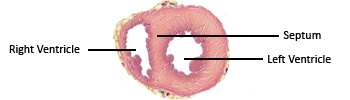
Ventricle Anatomy

The has a thinner wall than the left ventricle, reflecting the lower resistance of the pulmonary versus the systemic circulation. In this specimen, the outer wall collapsed onto the ventricular septum.

  • Trabeculae Carneae (,): Prominent irregular, branching muscular ridges projecting from the outer wall into the chamber lumen
    • Some are attached along their entire length, while others bridge across the chamber, attached only at their endpoints
    • Notably less developed on the septal side
  • Papillary Muscles: Three (visible in cross-section) give rise to fibrous cords (chordae tendineae) that attach to the cusps of the tricuspid valve
  • Interventricular Septum: separating the right and left ventricles
    • Characteristically with minimal trabeculation
    • Bulges into the right ventricle during contraction (systole) to enhance ejection efficiency

The micro-architecture of the trabeculae carneae and papillary muscles is better appreciated in gross specimens or three-dimensional imaging.

Courtesy of Edward B. Lankford, Division of Cardiology, Penn State Heart and Vascular Institute, University Park, State College, PA.

Ventricular Wall

See MH 070 Heart for a more detailed explanation of the ventricular walls

The consists of three layers:

  • Endocardium (): Simple squamous epithelium (endothelium) lines the chamber
    • Flattened nuclei are visible in well-preserved regions
    • Rests on a thin layer of subendothelial connective tissue containing collagen and elastic fibers
  • Myocardium (): Cardiac muscle form the bulk of the wall thickness
    • Individual display branching morphology with one or two centrally positioned nuclei
    • Eosinophilic cytoplasm reflects dense packing of contractile myofibrils and mitochondria
    • Intercalated discs appear as dark transverse lines between adjacent cells
  • Epicardium (): Outer visceral pericardium layer, consisting of the mesothelium and underlying connective tissue
© 2005-2026. T. Clark Brelje and Robert L. Sorenson